
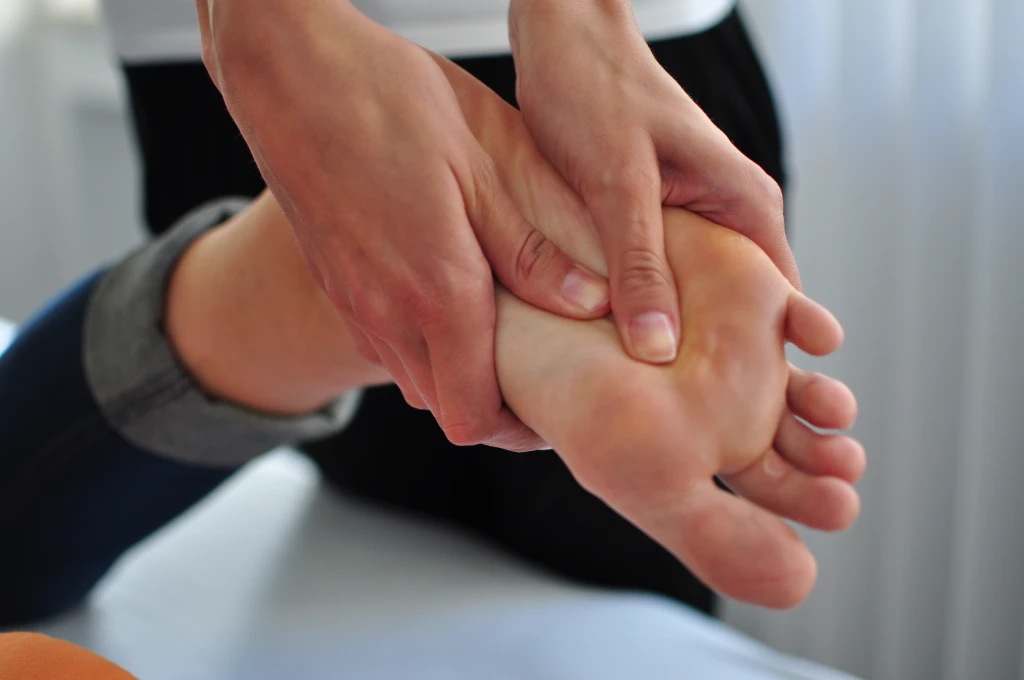
You take your shoes off at the end of a long day and the ball of your foot is burning, as though a small stone has been sitting under the skin near the toes. It feels worse barefoot on the hard floors at home, and a day in heels or firm dress shoes leaves the area under the toes tender and bruised. Some people also notice numbness or tingling spreading toward the toes, and the ache tends to ease the moment the foot is rested.
Metatarsalgia is really a description of where the pain sits, at the ball of the foot over the metatarsal heads, rather than a single diagnosis. Several different structures can generate that pain, from an overloaded fat pad to an irritated nerve, a strained ligament, or a stressed bone. Because the cause is what guides the treatment, identifying which structure is responsible matters far more than the label itself.
Symptoms of Metatarsalgia
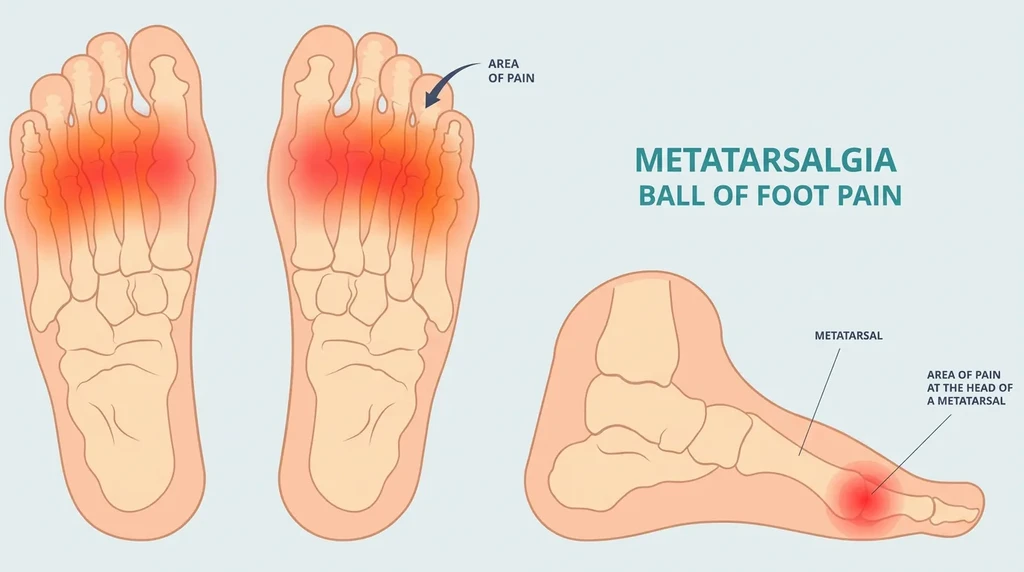
Metatarsalgia symptoms centre on the ball of the foot and are usually brought on by weight-bearing and eased by rest. The exact pattern often hints at which underlying structure is involved.
- Pain under the ball of the foot: an aching, burning, or bruised feeling over the metatarsal heads, just behind the toes, that builds with time on your feet.
- A sensation of walking on a pebble: many people describe a lump or a scrunched sock under the forefoot even when nothing is there.
- Pain that worsens barefoot on hard floors or in unsupportive shoes: loading the forefoot on tiles, in heels, or in thin flat sandals reproduces the ache.
- Numbness, tingling, or burning toward the toes: suggests a nerve in the forefoot is being irritated rather than a purely mechanical overload.
- Stiffness or pain when moving a toe: points more towards a joint or ligament source under the affected toe.
- Occasional swelling or redness: less common, but when present it flags active inflammation and warrants a closer look.
Types of Metatarsalgia
Metatarsalgia is often grouped by what is driving the forefoot overload, which helps direct the assessment and the plan.
Primary metatarsalgia
Pain that comes from the anatomy and alignment of the forefoot itself. A long second metatarsal, a high arch that tips extra load onto the ball of the foot, a prominent metatarsal head, or a thinning fat pad can each concentrate pressure under one or two metatarsal heads. The mechanics of the foot are the direct source of the overload.
Secondary metatarsalgia
Pain that arises because another condition has changed how the forefoot loads. An irritated nerve, a strained plantar plate, inflammation in a toe joint, or an inflammatory arthritis such as rheumatoid arthritis or gout can all present as pain over the ball of the foot. Here the metatarsalgia is a symptom of the underlying problem, which is why the assessment looks past the pain to the driver.
Iatrogenic metatarsalgia
Pain that follows previous forefoot surgery, such as bunion correction, where the load distribution across the metatarsal heads has shifted and now overloads a neighbouring one. It is less common, but worth identifying because the management is guided by the earlier surgery.
Causes of Metatarsalgia
A flat pattern of forefoot overload usually develops from a combination of how the foot is built, what it is asked to do, and what it is shod in.
What causes metatarsalgia?
- Forefoot overload from activity: high-impact sport such as running, court sports, or dance, a sudden jump in training volume, or repeated landings concentrate force through the ball of the foot.
- Footwear that loads the forefoot: heels, thin flat sandals, and shoes with little cushioning or a narrow toe box all push more pressure onto the metatarsal heads.
- Foot shape and biomechanics: a high arch, a long second metatarsal, a prominent metatarsal head, or a bunion that offloads the big toe onto its neighbours all raise local pressure.
- A thinning forefoot fat pad: the natural cushion under the metatarsal heads thins with age, leaving the bones less protected.
- Related forefoot conditions: an irritated nerve, a strained plantar plate, or inflammation in a toe joint can each set off pain at the ball of the foot.
- Barefoot training on hard surfaces: removing the shoe’s cushioning while loading the forefoot is a common aggravator.
Who carries a higher baseline risk?
- Runners, dancers, and people who play court or field sports that load the forefoot.
- People who spend long days in heels or thin, unsupportive footwear, a common pattern in Singapore’s work and humid-weather sandal culture.
- Adults over 50, in whom the forefoot fat pad naturally thins. In a large cohort with an average age of 66, about 28% had forefoot fat pad atrophy.
- People with a high arch, a long second metatarsal, a bunion, or clawed toes.
- People carrying higher body weight, which adds load through the forefoot.
- People with an inflammatory arthritis such as rheumatoid arthritis or gout affecting the toe joints.
Conditions Commonly Mistaken for Metatarsalgia
Because metatarsalgia only describes where the pain sits, several distinct forefoot conditions share the same territory and need to be told apart, since their management differs. The patterns most often confused with general metatarsalgia are below.
Morton’s neuroma
A Morton’s neuroma is a thickening of the tissue around a nerve between the metatarsal heads, most often between the third and fourth toes. The clue is a burning or electric pain with numbness or tingling into the affected toes, sometimes with a clicking sensation when the forefoot is squeezed. Where general metatarsalgia is a deep bony ache, a neuroma has a distinctly nerve-like quality.
Sesamoiditis
Sesamoiditis is inflammation of the two small sesamoid bones beneath the big toe joint. The pain sits specifically under the big toe rather than across the lesser metatarsal heads, and it worsens when the big toe is bent up during push-off. Its focal location under the first toe separates it from a broader forefoot ache.
Plantar plate injury
A plantar plate injury is a strain or tear of the ligament under a lesser toe joint, most often the second. It tends to produce pain right at the base of the toe, sometimes with the toe starting to drift or lift out of line. Tenderness pinpointed to the joint at the base of one toe helps distinguish it from generalised metatarsalgia.
Stress fracture of a metatarsal
A stress fracture of a metatarsal is a small crack in one of the long forefoot bones, usually from a spike in impact loading. The clue is a sharper, more localised pain over a specific point on the bone, often with swelling, that worsens the longer the foot is loaded. Because continued loading can widen the crack, a suspected stress fracture needs timely identification and imaging.
Freiberg’s disease
Freiberg’s disease is a loss of blood supply to the head of a metatarsal, usually the second, most often seen in adolescents and young adults. It causes pain and stiffness in the affected joint that can be mistaken for ordinary forefoot overload, and it is confirmed on imaging because the changes are within the bone itself.
Intermetatarsal bursitis
Intermetatarsal bursitis is inflammation of a small fluid-filled sac between the metatarsal heads. It can feel very similar to a neuroma or general metatarsalgia, with a swollen, tender area between the bones. Because it frequently sits alongside a neuroma or a plantar plate problem, it is assessed together with the surrounding structures rather than in isolation.
Treating and Preventing Metatarsalgia
Because metatarsalgia describes where the pain sits rather than what is causing it, treatment starts by identifying the underlying source, then reduces the load on the forefoot and calms the irritated tissue. The principle is conservative first: most cases settle once the specific cause is clear and the pressure over the metatarsal heads is redistributed, and care is matched to whether the pain is driven by forefoot overload, a nerve, a joint, or a bony structure.
Conservative treatment
Conservative care usually centres on offloading the ball of the foot and settling the irritated tissue, matched to the underlying cause and combined rather than used one at a time.
- Activity modification: stepping back to lower-impact activity, resting and icing where swelling is present, and avoiding barefoot walking or training while the forefoot settles.
- Footwear: switching to supportive, cushioned shoes with a roomier toe box reduces pressure through the ball of the foot, and swapping thin flat sandals for a structured pair helps for long days on your feet.
- Taping and padding: a metatarsal pad or taping redistributes pressure away from the sore part of the forefoot.
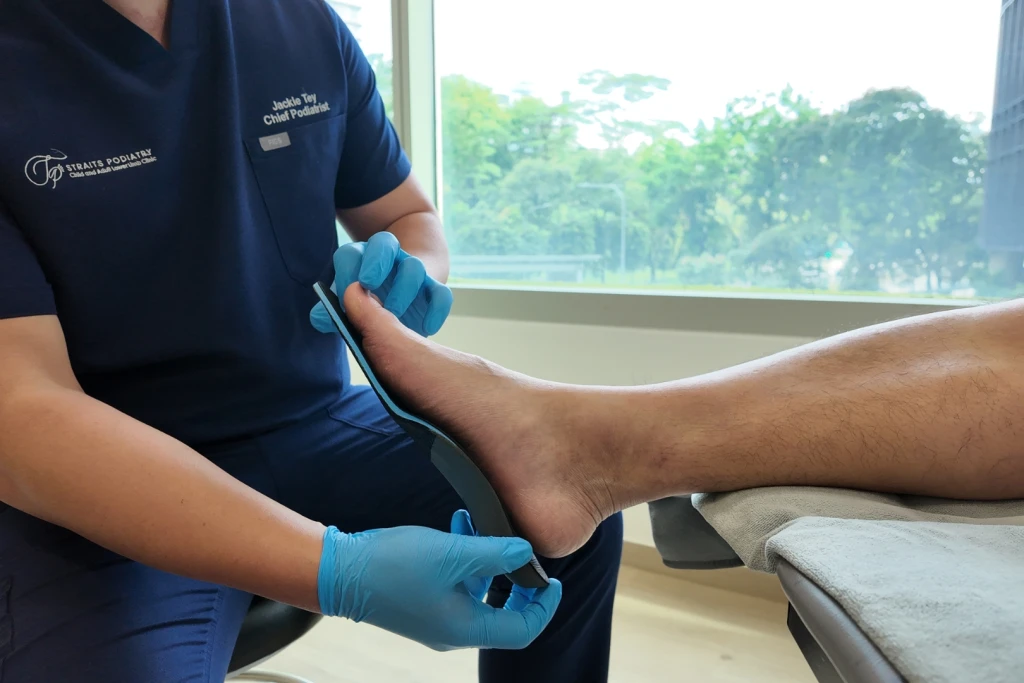
- Custom foot orthoses: made to your foot shape and pressure pattern, with a metatarsal dome positioned just behind the metatarsal heads to lift load off them.
- Extracorporeal shockwave therapy: used to help settle pain and inflammation in cases that have not responded to footwear and offloading.
- Magnetotransduction therapy (EMTT): used where pain and inflammation in the forefoot have been persistent, alongside the offloading measures.
Where a tight calf is adding to the forefoot load, our physiotherapist can guide calf stretching and a graded strengthening programme so the foot tolerates load better as symptoms settle.
When conservative care isn’t enough
Because metatarsalgia is an umbrella term, what happens next depends on the specific condition found. Where forefoot pain does not settle with conservative care, the underlying cause, such as a neuroma, a plantar plate tear, or a stress fracture, is reviewed more closely. Where a procedure or a surgical opinion is warranted for that particular diagnosis, a referral to an orthopaedic surgeon is arranged. Surgery is a last resort rather than a first option, and most people never reach that stage with timely conservative management.
Preventing Metatarsalgia
Not every case can be prevented, but a few habits reduce the chance of forefoot pain returning. Build training load gradually rather than in sudden jumps, and keep the forefoot cushioned with supportive footwear rather than thin flat sandals for long days out. Maintain calf and foot flexibility and strength so the forefoot is not taking more than its share of load, keep body weight in a healthy range to limit the pressure passing through the ball of the foot, and address the foot-shape or footwear factors that concentrated pressure in the first place. If forefoot pain keeps returning each time activity increases, have it assessed early rather than working through it.
Have Your Metatarsalgia Managed at Straits Podiatry
When pain at the ball of the foot keeps catching you on every step, treating the symptom without identifying the underlying source tends to lead to recurrence. Our podiatrist assesses where the pain is concentrated, your activity pattern, your footwear, your foot shape and fat-pad coverage, and your gait, so the specific cause can be identified before any care begins.
From there, the plan is built around your daily routine, and can include gait analysis, custom orthotic insoles to redistribute forefoot pressure, footwear guidance, shockwave therapy or EMTT for cases that have not settled with offloading, and rehabilitation with our physiotherapist where a tight or weak calf is adding to the load. If forefoot pain is limiting your walking or your sport, speak with a podiatrist in Singapore or book a consultation for an assessment.
Frequently Asked Questions About Metatarsalgia
What is metatarsalgia?
Metatarsalgia is a clinical description of pain at the ball of the foot rather than a single diagnosis. It tells you where the pain sits, over the metatarsal heads just behind the toes, not what is causing it. Conditions that present as metatarsalgia include a thinning fat pad and forefoot overload, an irritated nerve, sesamoiditis, a plantar plate strain, a metatarsal stress reaction, and inflammatory arthritis, so an assessment is needed to identify which one is responsible before a plan is set.
What causes pain in the ball of the foot?
Forefoot pain usually develops from a combination of load, footwear, and foot shape. High-impact activity or a sudden increase in training, shoes that push pressure onto the forefoot such as heels or thin flat sandals, a thinning fat pad that comes with age, and foot-shape factors such as a high arch or a long second metatarsal all concentrate pressure under the ball of the foot. A nerve being irritated in the forefoot can add a burning or tingling quality to the pain.
Can metatarsalgia go away on its own?
Sometimes. Mild forefoot pain triggered by an obvious cause, such as a training spike, a barefoot session, or a long day in unsupportive shoes, often settles once that load is reduced and supportive footwear is reintroduced. Pain that lasts more than a couple of weeks, returns whenever activity resumes, or comes with swelling, numbness, or a walking-on-a-pebble feeling usually points to an underlying condition that keeps flaring without targeted care. A stress reaction in particular needs timely identification, because continued loading can progress it to a stress fracture.
When should I see a podiatrist for forefoot pain?
Consider an assessment if pain at the ball of the foot lasts more than two weeks, limits your usual walking or sport, comes with swelling, numbness, tingling, or a clicking sensation in a toe, or keeps returning each time activity increases. Earlier review usually shortens recovery, because identifying the specific condition and the mechanical factors driving it lets the care address the cause rather than only the flare.
Do insoles or metatarsal pads help metatarsalgia?
Often, when the forefoot is taking more load than it should and the goal is to redistribute pressure away from the painful area. What matters is a metatarsal dome or pad placed just behind the sore joints to lift pressure off the metatarsal heads, a cushioned forefoot to absorb impact, and support that controls how the foot loads through the midfoot. Off-the-shelf insoles vary widely, and many include cushioning but no pad, or place the pad in the wrong spot, which can make symptoms worse. A custom orthosis is made to your foot shape, pressure pattern, and the underlying diagnosis, so the pad position and support are matched to the cause. Insoles work best alongside footwear and load changes rather than as a standalone fix.
Is metatarsalgia the same as Morton’s neuroma?
No. Metatarsalgia is a general term for pain over the ball of the foot, while a Morton’s neuroma is one specific cause of it, a thickening of the tissue around a nerve between the metatarsal heads. A neuroma tends to bring a burning or electric pain with numbness or tingling into the toes and sometimes a click when the forefoot is squeezed, whereas general metatarsalgia is more often a deep bony ache. Because a neuroma is only one of several possible drivers, an assessment identifies whether a nerve, a joint, a ligament, or simple overload is behind the pain.