

You push off hard to sprint, drop into a deep squat, or come down a flight of stairs, and a sharp pinch bites at the front of your ankle, right where the foot meets the shin. On flat ground it feels fine, but the moment you force the ankle to bend up fully, it catches and blocks, sometimes leaving a dull ache afterwards. Footballers, runners, and anyone who loads the ankle at its end range tend to notice it most.
That catching, blocked feeling is ankle impingement: soft tissue or bone getting pinched between the bones of the ankle joint at the extremes of movement. This page focuses on the more common anterior (front-of-ankle) pattern, though impingement can also occur at the back of the ankle. It is a mechanical pain pattern rather than a single injury, which is why it keeps returning with the same movements until the underlying driver is addressed.
Symptoms of Ankle Impingement
Ankle impingement symptoms tend to cluster around a specific movement rather than a constant ache, and they become more noticeable the harder the ankle is loaded. The following signs can help you recognise how it presents:
- Pain at the end of motion: a sharp pinch at the front or back of the ankle when the joint is pushed to its full range, such as squatting deep or pointing the toes down.
- A blocked or catching feeling: the ankle feels like it hits a hard stop before it reaches full movement.
- Pain that worsens with activity: discomfort builds with running, jumping, or repeated loading, and eases with rest.
- Swelling and tenderness: the affected front or back of the ankle can feel puffy and tender to press.
- Stiffness and reduced range: the ankle does not bend up or point down as freely as the other side.
- Clicking or catching: a click or catch can be felt during the specific movements that provoke the pinch.

Types of Ankle Impingement
Ankle impingement is grouped by where the pinch happens, and the location shapes both the movements that trigger it and the structures involved.
Anterior ankle impingement
Anterior (front-of-ankle) impingement is the more common pattern. It is provoked when the ankle bends upward, such as squatting, lunging, or pushing off to sprint, and is often linked to bone spurs at the front of the joint or to thickened soft tissue left behind by previous ankle sprains. Footballers and runners are the classic presentations.
Posterior ankle impingement
Posterior (back-of-ankle) impingement is provoked when the ankle points downward, such as pointing the toes in dance or striking a ball with the top of the foot. In people with an Os Trigonum, an extra bone some are born with at the back of the ankle, that downward motion squeezes the bone and its surrounding soft tissue between the back of the shinbone and the heel bone, producing the pinch of posterior ankle impingement.
Causes of Ankle Impingement
Ankle impingement develops when something changes how the ankle joint compresses at its end range, whether that is extra bone, scarred soft tissue, or the way the foot is loaded. In most cases it is a combination of factors rather than a single cause.
What Causes Ankle Impingement?
- Repetitive high-impact loading through movements that push the ankle to its full range, such as jumping, sprinting, or sudden changes of direction.
- A previous ankle sprain that healed with scar tissue or thickened soft tissue, which then gets pinched during movement.
- Previous ankle surgery, where the surgical site can build up scar tissue that later gets pinched during movement.
- Bone spurs at the front of the joint, which can form as the joint surface wears over time.
- Foot mechanics, since overpronation in flat feet and over-supination in high arches shift how the joint compresses at end range and, over time, add to wear and tear on the ankle joint.
Who Carries a Higher Baseline Risk?
- Athletes in sports with repeated end-range ankle loading, such as football, running, basketball, and ballet.
- People with a history of ankle sprains or earlier ankle injury.
- Those with flat feet or high arches, whose foot posture alters how the ankle joint loads.
- People with early ankle joint wear or bone spurs.
- Dancers and footballers in particular, for the posterior pattern linked to pointing the foot down.
Conditions Commonly Mistaken for Ankle Impingement
Because the pain sits around the ankle and often follows a sprain, impingement is easily confused with other conditions that share the same triggers. Proper assessment, and imaging where needed, is what tells them apart.
Talar dome injury
A talar dome injury is damage to the cartilage on top of the talus, and it also tends to follow a sprain and produce deep ache and catching. The difference is that impingement pain sits at the joint margins and flares at end range, while a talar dome injury is felt deeper within the joint and can persist through mid-range movement.
Ankle osteoarthritis
Early ankle osteoarthritis can also cause end-range stiffness, bone spurs, and pain with loading. In practice the two often overlap, since the same bone spurs that mark early joint wear can be the structures doing the pinching, which is why an accurate assessment matters before deciding on care.
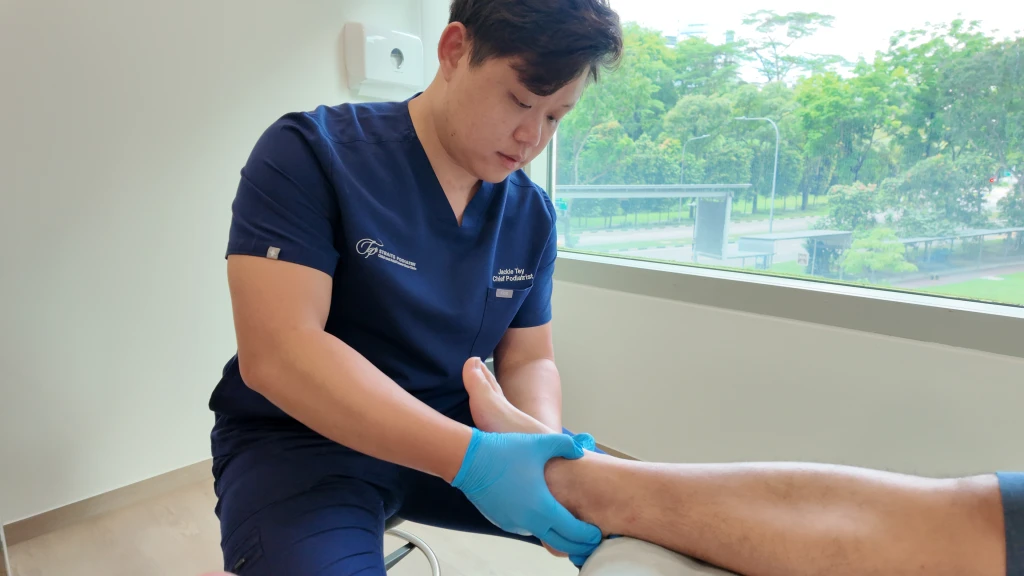
Treating and Preventing Ankle Impingement
Ankle impingement is a mechanical pain pattern, so care starts by reducing the load and movements that provoke the pinch, then addresses the underlying driver, whether that is scar tissue from a previous injury, foot mechanics, or a bony block. Conservative measures settle most cases and are always the first line, because they calm the irritated tissue while correcting how the joint is loaded. Interventional options are reserved for the cases that do not respond and for structural blocks that will not settle without them.
Conservative treatment
Most cases settle with load management, supportive measures, and correcting the mechanics that drive the pinch.
- Activity modification and load management: Resting from the provoking activity for an initial period lets the inflammation and pain subside. Switching to lower-impact activity keeps you moving without forcing the ankle to its painful end range, and short-term over-the-counter pain relief can help settle a flare.
- Rehabilitation and physiotherapy: Physiotherapy builds strength and mobility around the ankle and restores control through the range of motion that provokes the pinch, which is central to a lasting recovery.
- Custom orthotics and footwear: A custom orthotic can control excessive pronation or supination and change how the joint loads, and in some cases an ankle-foot orthosis adds stability where the joint needs more support. Supportive footwear reduces the end-range loading that aggravates the pinch.
- Heel lift: For anterior impingement, a small heel lift in the shoe reduces how far the ankle has to bend upward, lowering the likelihood of reaching the painful end range and easing the pinch at the front of the joint.
- Focused shockwave therapy: Focused shockwave therapy (ESWT) uses acoustic waves to stimulate the body’s natural healing response and can help settle stubborn soft-tissue irritation, though it can be uncomfortable during the session and usually needs several visits.
Preventing recurrence comes down to the same principles: build training load gradually, keep the calf and ankle strong and mobile, wear footwear that suits your foot type, and address foot mechanics early rather than repeatedly loading the joint into its painful range.
When conservative care isn’t enough
Where conservative care has been given a fair trial and pain still limits walking, sport, or work, a corticosteroid injection may be considered to settle pain and inflammation, though the effect can be temporary and symptoms can return. In cases where imaging confirms a structural block, such as a sizeable anterior bone spur or a symptomatic Os Trigonum, surgery may be needed to remove the offending soft tissue or bone. This is usually arthroscopic surgery performed by a foot and ankle surgeon, and as with any operation there are risks to weigh. Where the clinical picture calls for surgical review, Straits Podiatry refers on to an orthopaedic specialist.
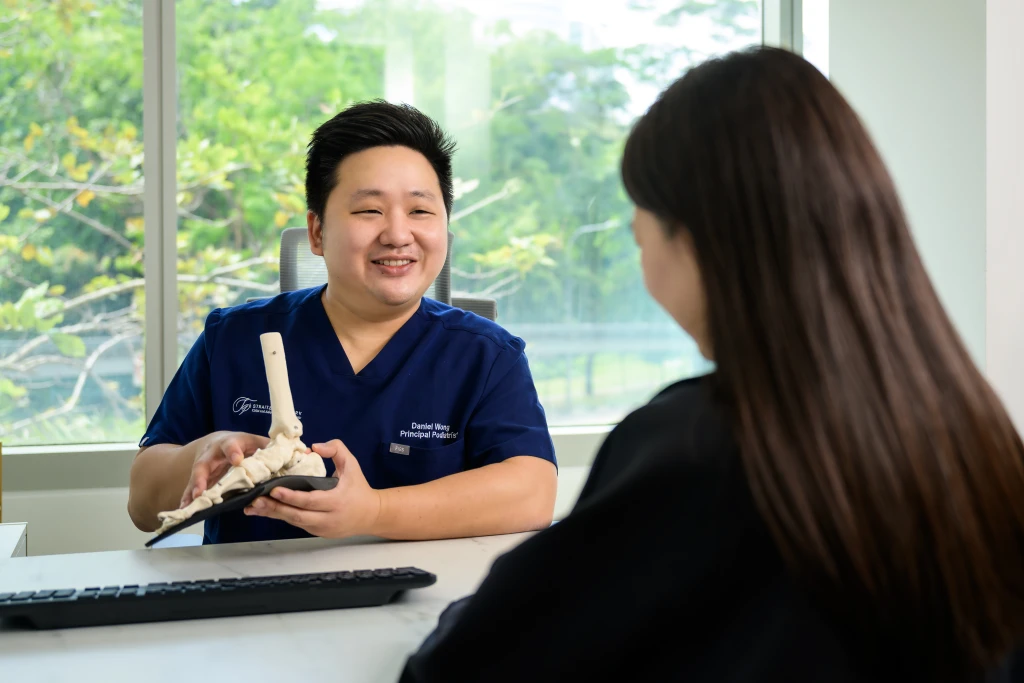
Have Your Ankle Impingement Managed at Straits Podiatry
When ankle pain keeps catching you mid-stride, pushing through it without a clear cause tends to drag the recovery out. At Straits Podiatry, the assessment looks at where the pinch occurs, the movements that bring it on, prior ankle injuries, your footwear, and your gait pattern, so the driver of the impingement is clear before any care begins.
From there, the plan is built around your daily routine and may include gait analysis, custom orthotic insoles, footwear guidance, focused shockwave therapy for cases that have not settled, and an ankle-foot orthosis where joint control needs extra support. Speak with our team or book a consultation for a thorough assessment and a tailored path back to comfortable movement.
Frequently Asked Questions About Ankle Impingement
Can I keep training or playing sport with ankle impingement?
It depends on how much the pinch is limiting you. Light activity that stays out of the painful end range is often fine, but pushing repeatedly into the movement that provokes the catch tends to keep the tissue irritated and slows recovery. The more useful approach is to modify training so you keep moving while the ankle settles, then rebuild the provoking range under guidance. If sport is consistently cut short by the pinch, it is worth having the ankle assessed before it becomes a recurring problem.
What causes ankle impingement?
Ankle impingement usually develops from one or a combination of repeated high-impact loading, scar tissue or thickened soft tissue from a previous ankle sprain, an extra bone such as an Os Trigonum at the back of the ankle, or bone spurs that form as the joint wears. Foot mechanics also play a role, since overpronation in flat feet and over-supination in high arches change how the ankle joint compresses during movement.
When should I see a podiatrist for ankle impingement?
Book an assessment to see a podiatrist in Singapore if ankle pain limits sport, walking, or stair use for more than a couple of weeks, if a previous sprain has left ongoing pinching or stiffness, or if a clicking or catching sensation keeps recurring during the same movements. Earlier review usually shortens recovery, because identifying the mechanical driver (foot posture, prior injury pattern, footwear) lets the plan address the cause rather than only the flare.
How long does ankle impingement take to settle?
Settle time depends on the cause and how long the impingement has been present. Mild anterior ankle impingement driven by activity load often improves within a few weeks once loading is reduced and the right support is in place. Cases linked to scar tissue, foot mechanics, or bone spurs typically take longer, often a few months, and benefit from a structured plan combining orthotic support, focused shockwave where indicated, and progressive rehabilitation. Cases that fail to settle with conservative care may need surgical assessment.
When is surgery considered for ankle impingement?
Surgery is considered when conservative care has been tried adequately and pain still limits walking, sport, or work, or when imaging confirms a structural block that will not respond to non-surgical input, such as a sizeable anterior bone spur or a symptomatic Os Trigonum. The common procedure is arthroscopic debridement, where the pinched soft tissue or bone is removed through small portals. Surgery is performed by a foot and ankle surgeon, not a podiatrist. Our role is to work through the conservative pathway first, including footwear, orthoses, focused shockwave where indicated, and rehabilitation, and to refer onward to an orthopaedic specialist if the clinical picture calls for surgical review. Most patients who reach surgery still benefit from podiatry input afterward to address the foot mechanics that contributed to the impingement in the first place.