
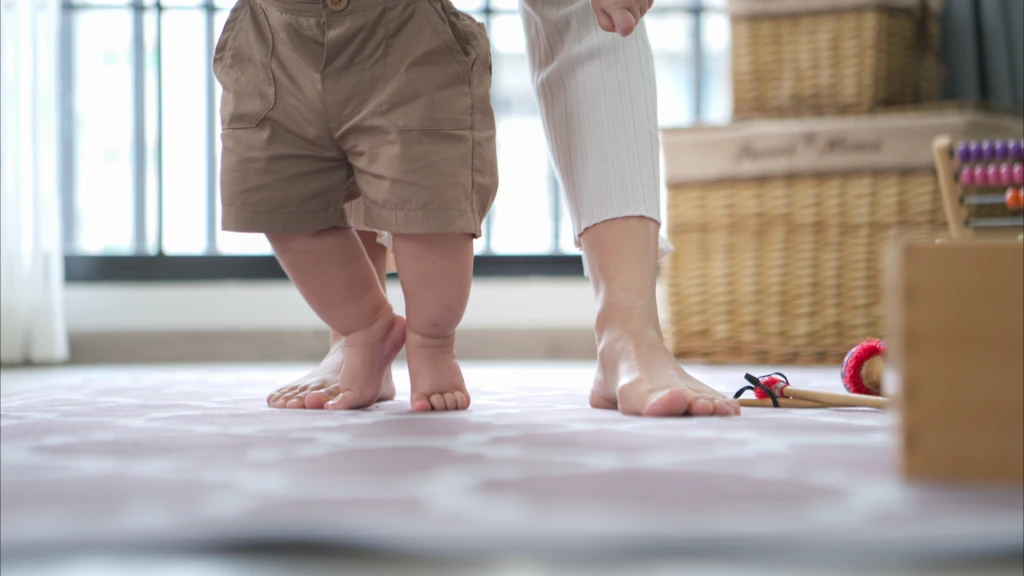
If your child walks on the balls of their feet without their heels touching the ground, you are looking at toe walking, often described by parents as walking on tippy toes. It is common in toddlers learning to walk and usually settles into a normal heel-to-toe pattern by around age 2. When it persists past that age, becomes the default pattern, or appears alongside developmental concerns, an assessment is worthwhile. Toe walking can be entirely benign, run in families, or, in a smaller number of children, point to an underlying neurological or muscular condition.
The right plan depends on the type. A paediatric assessment helps work out whether your child has developmental toe walking that will settle, idiopathic toe walking with no apparent cause, or toe walking linked to an underlying condition that needs onward referral. The earlier the type is sorted, the more options there are to influence the pattern.
Symptoms of Toe Walking
- Walking on the balls of the feet without the heels touching the ground.
- A “bouncing” gait pattern.
- Toe walking that gets more pronounced when the child is excited, running, or hurrying.
- Toe walking on certain surfaces, such as carpet, grass, or sand.
- Difficulty squatting flat-footed or standing with the heel down.
- Calf tightness.
- Frequent tripping or balance difficulty as the child gets older.
- Reduced ankle range of motion when the foot is pushed up at the ankle.
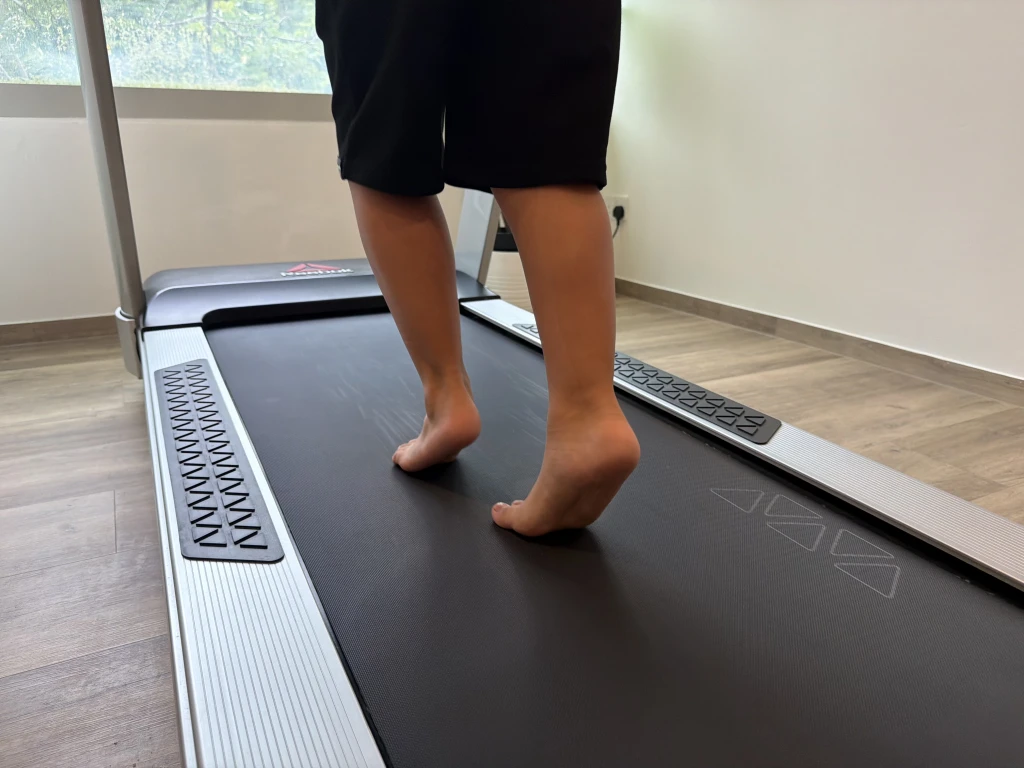
Types of Toe Walking
Developmental Toe Walking
Common in toddlers as part of learning to walk. There is no underlying neurological or muscular condition. The pattern usually settles by around age 2 to 3.
Idiopathic Toe Walking
Toe walking that persists past age 3 without an obvious cause. There is often a strong family history. The child is otherwise developing normally.
Toe Walking Linked to an Underlying Condition
Toe walking associated with conditions such as autism spectrum disorder, cerebral palsy, muscular dystrophy, clubfoot, or a sensory integration difference. The toe walking can be one of the earlier observable signs, which is why assessment matters.
Causes of Toe Walking
What Causes Toe Walking?
- Normal early development of walking that has not yet settled into heel-to-toe pattern.
- A strong family history of toe walking with no underlying condition.
- Tight calf muscles or a shortened Achilles tendon.
- Habitual toe walking that has become the default pattern over years.
- Sensory differences, where the child prefers reduced foot contact with certain surfaces.
- Neurological conditions such as autism spectrum disorder.
- Neuromuscular conditions such as cerebral palsy or muscular dystrophy.
- Congenital foot conditions such as clubfoot.
- Hypermobility at the foot and ankle.
Who Carries a Higher Baseline Risk?
- Children with a family history of toe walking.
- Children with autism spectrum disorder or other neurological conditions.
- Children with cerebral palsy or other neuromuscular conditions.
- Children with a history of clubfoot or other congenital foot deformities.
- Children with sensory integration differences.
- Children with tight calves or limited ankle mobility.
Conditions Commonly Mistaken for Toe Walking
A few other gait patterns can look similar to persistent toe walking. A paediatric assessment tells them apart and rules out underlying conditions that need onward referral.
In-toe walking
In-toe walking is when the feet point inward during walking, rather than the child walking up on the toes. The two describe different parts of the gait, and a child can have one without the other. Assessment looks at foot position and heel contact separately to tell them apart.
Heel pain
Heel pain can make a child avoid putting the heel down and walk on the front of the foot to stay comfortable. This can look like toe walking but is driven by pain rather than habit or a tight calf, so the child usually walks normally once the heel is no longer sore.
Stiff ankle from a previous injury
A stiff ankle after a past injury can limit how far the foot moves upward, pushing the child onto the forefoot. Here the limited motion is mechanical and often on one side only, unlike habitual toe walking, which is usually present on both sides with full ankle movement.
Treating and Preventing Toe Walking
The first step is identifying which type of toe walking your child has, because the management plan is built around it. Developmental toe walking in toddlers under age 3 usually needs monitoring rather than active treatment, with periodic review to confirm the pattern is settling. Idiopathic toe walking and toe walking linked to underlying conditions often benefit from earlier intervention, since both calf tightness and habit reinforcement progress over time.
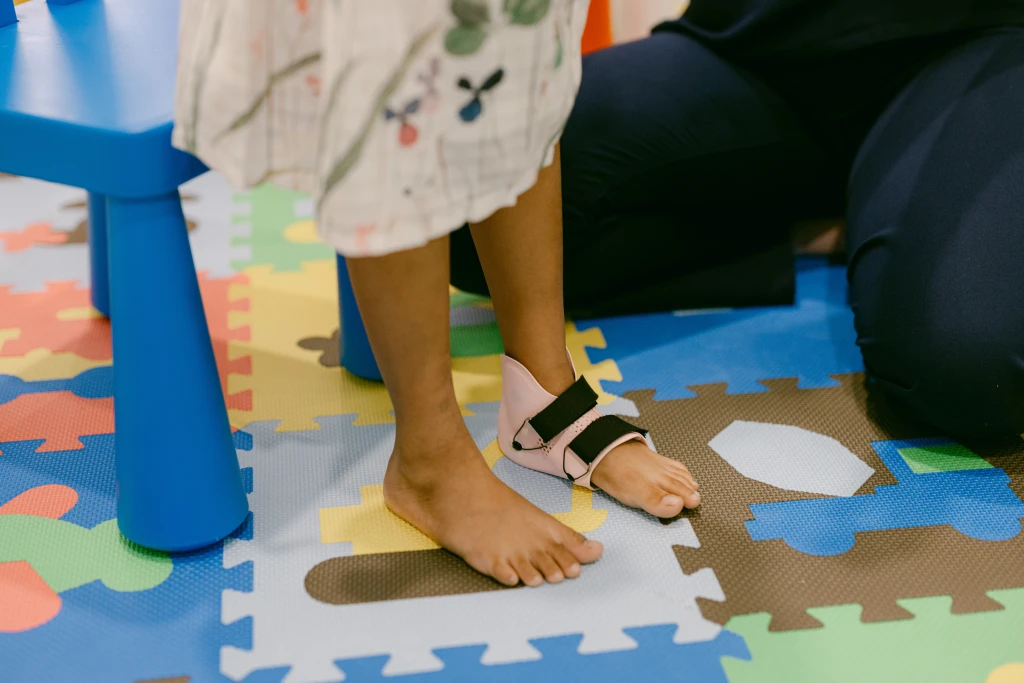
Stretching the calves and Achilles is a foundation of most plans, often combined with strengthening of the muscles that lift the foot. A gait retraining programme helps the child feel and use a heel-strike pattern during everyday walking. Custom orthotics can support foot position during the gait retraining phase. Paediatric supramalleolar orthoses or ankle-foot orthoses provide more controlled positioning of the foot and ankle when the calf is very tight or the pattern is severe. For persistent muscular tightness, radial pressure wave therapy is sometimes used to release the calf. Where an underlying condition is suspected, onward referral to paediatric medical care is part of the plan.
Earlier review gives a longer window to influence the pattern before muscles and tendons remodel around it.

Have Your Toe Walking Managed at Straits Podiatry
Paediatric foot and gait conditions are seen at all three Straits Podiatry clinics in Buona Vista, Orchard, and Paya Lebar, where our podiatrists work with children of all ages. Straits Podiatry is part of Healthway Medical Group.
A paediatric assessment for toe walking includes a paediatric assessment, gait analysis, calf and ankle flexibility testing, footwear review, and where indicated, custom orthotics, paediatric supramalleolar orthoses, a stretching and gait retraining programme, and onward referral if an underlying condition is suspected.
Speak with Straits Podiatry or book a consultation for an assessment and a tailored approach to manage your child’s toe walking.
Frequently Asked Questions About Toe Walking
Will my child grow out of toe walking?
Many do. Developmental toe walking in toddlers under age 3 often settles on its own as walking matures. Idiopathic toe walking can persist longer, especially when there is a family history, and may not fully resolve without intervention. Toe walking linked to an underlying condition needs management of the underlying issue, not just the gait. Outgrowing is the usual path for early developmental toe walking but should not be assumed past age 3, since calf tightness and habit reinforcement tend to compound with time.
When should I see a podiatrist about toe walking?
Book an assessment if your child is still toe walking past age 2 to 3, if toe walking is the default rather than occasional pattern, if there is calf tightness or limited ankle range, if there are concerns about other aspects of development, or if you have noticed clumsiness or frequent falls. Earlier review gives more options, since calf and Achilles tightness becomes harder to reverse the longer the pattern has been in place.
Does my child need braces or orthotics?
Not always. For mild toe walking that is improving with stretching and gait retraining, supportive footwear alone may be enough. Custom orthotics are useful during the retraining phase to support foot position. Paediatric supramalleolar or ankle-foot orthoses are considered when the calf is very tight, when stretching alone is not changing the pattern, or when more controlled positioning of the foot and ankle is needed for the child to feel a heel-strike. The decision is made after a paediatric assessment.
Could toe walking be a sign of something else?
Sometimes. Most toe walking is benign and either developmental or idiopathic. A smaller number of children toe walk as one of the earlier signs of an underlying condition such as autism spectrum disorder, cerebral palsy, muscular dystrophy, or a sensory integration difference. A paediatric assessment screens for those features and arranges onward referral when indicated. Picking up an underlying condition earlier is one of the practical reasons to have persistent toe walking assessed rather than waiting it out.
Will toe walking affect my child long-term?
For most children, no, especially when developmental or mild idiopathic toe walking settles or is treated during the growing years. Persistent toe walking can lead to a permanently tight calf and Achilles, reduced ankle range, balance issues, frequent ankle sprains, and an awkward running pattern in sport. Addressing it during the growing years, while muscles and tendons are still responsive, reduces those longer-term risks.