
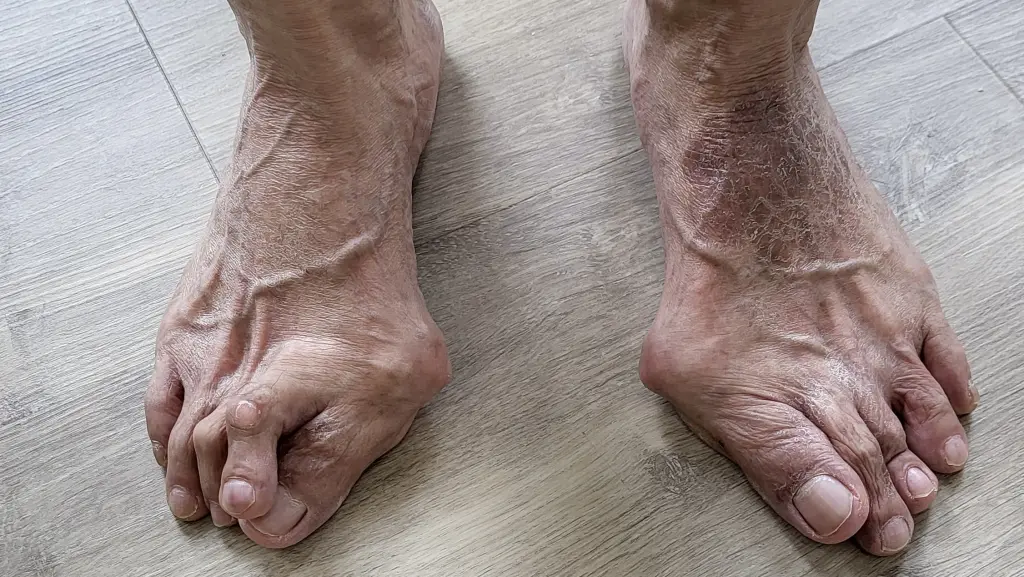
You notice your feet feel stiff and sore for the first hour each morning, the front of the foot has started aching with standing, and shoes that used to fit comfortably now press uncomfortably across the toes. Over months, you may have noticed the toes drifting outwards, a bunion forming at the big toe, or the arch beginning to collapse. For some people, the feet are the first place rheumatoid arthritis (RA) makes itself known.
Rheumatoid arthritis is a chronic autoimmune disease in which the immune system mistakenly attacks the joint lining, leading to inflammation, joint damage, and over time, structural change. It is primarily a systemic condition managed by a rheumatologist with disease-modifying medication. The podiatry role is the foot-specific side, helping protect the joints, accommodate deformity, support gait, and ease day-to-day comfort. Both sides of care work together.
Symptoms of Rheumatoid Arthritis in the Feet
Foot involvement in RA often shows up early and follows a recognisable pattern:
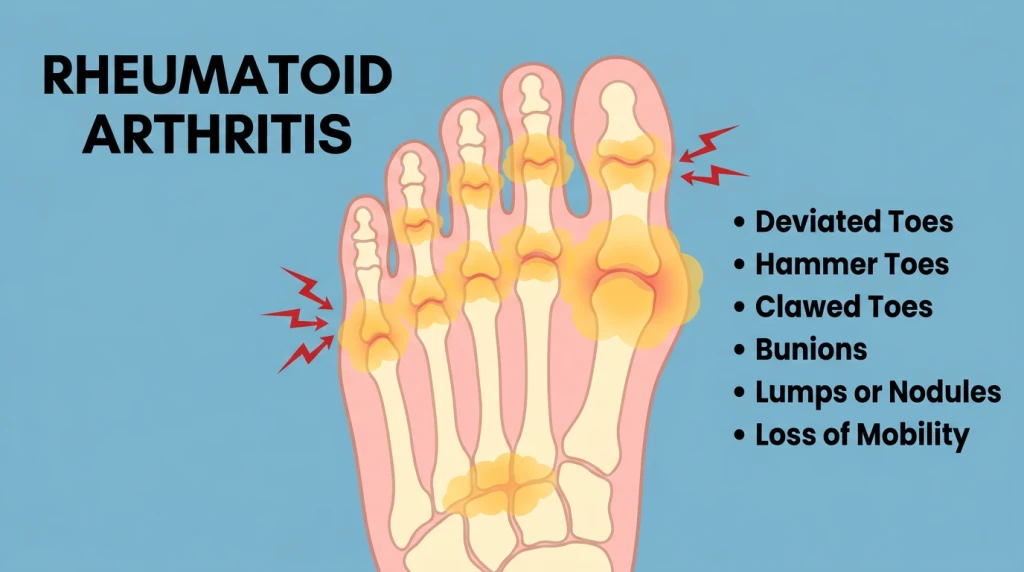
- Pain and stiffness in the foot joints, particularly the ball of the foot and the toe joints.
- Morning stiffness lasting more than thirty minutes, easing with movement through the day.
- Swelling, warmth, and tenderness over the affected joints.
- Symmetrical involvement, where both feet tend to be affected in the same areas.
- Toe joints drifting outwards, with progressive bunion formation and hammertoe changes.
- Collapse of the arch, contributing to a progressive flat foot deformity.
- Lumps or rheumatoid nodules under the skin, often in weight-bearing areas or pressure points.
- Reduced range of motion and difficulty with balance during walking.
Causes of Rheumatoid Arthritis
What Causes Rheumatoid Arthritis?
Rheumatoid arthritis is an autoimmune condition with multiple contributing factors. The exact trigger is not fully understood, but the disease involves the immune system attacking the synovium (the joint lining), which leads to inflammation and progressive joint damage.
- Autoimmune response where the immune system mistakenly targets the joint lining.
- Genetic factors, including specific HLA gene variations linked to a higher risk of RA.
- Environmental factors such as smoking and certain infections, which can increase risk or trigger disease activity.
- Hormonal factors, with RA more commonly diagnosed in women, suggesting an oestrogen-related influence.
- Other contributing factors, including obesity and possibly gut microbiome changes, which may add to baseline inflammation.
Who Carries a Higher Baseline Risk?
- Women, who are diagnosed with RA more commonly than men.
- People aged 30 to 60, the typical age range for adult-onset RA.
- People with a family history of rheumatoid arthritis or other autoimmune conditions.
- Smokers and people with significant past tobacco exposure.
- People carrying excess body weight, which contributes to systemic inflammation.
- People with other autoimmune conditions already diagnosed.
Diagnosing Rheumatoid Arthritis
RA is diagnosed by a rheumatologist through clinical assessment, blood tests (including rheumatoid factor and anti-CCP antibodies), and imaging where appropriate. Early diagnosis matters because early disease-modifying treatment helps prevent joint damage. If you have a family history of RA or unexplained joint pain, swelling, and morning stiffness that persists for weeks, a referral to a rheumatologist is the appropriate first step. Podiatry assessment supports the foot-specific side of the picture but is not how RA is diagnosed.
Treating and Preventing Foot Problems in Rheumatoid Arthritis
Rheumatoid arthritis is primarily managed through disease-modifying medication prescribed and monitored by a rheumatologist. These medications target the underlying immune activity that drives joint damage. There is no podiatric treatment that controls RA disease activity itself, and treatment of the systemic condition sits firmly with the rheumatology team.
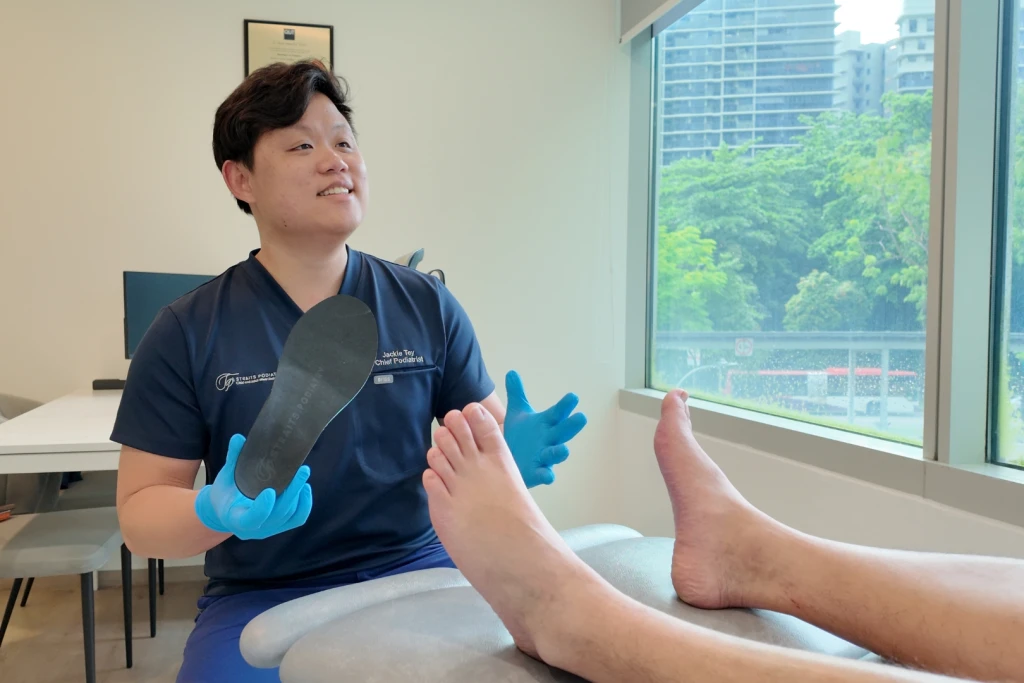
The podiatry role is foot-specific and works alongside rheumatology care. The focus is on protecting joints from further damage, supporting how the foot loads through gait, accommodating existing deformity to keep daily activity comfortable, and addressing pressure areas that can develop where deformities form. Footwear choice matters: shoes with adequate depth, a wide toe box, and good shock absorption reduce pressure on inflamed joints. Custom foot orthotics can offload painful areas and slow some patterns of progressive change. Physiotherapy helps maintain range of motion, muscle strength, and balance.
There is no way to prevent RA itself. What can be reduced is the cumulative foot damage that RA produces over years, by maintaining good footwear, addressing foot mechanics early, monitoring pressure areas, and staying in active communication with your rheumatology team. The earlier the foot side of care is started, the better the long-term outcome for foot function.

Have Your Rheumatoid Arthritis in the Feet Managed at Straits Podiatry
Straits Podiatry works alongside your rheumatologist. Assessment starts with a gait analysis and a structural foot review. Foot-specific care may involve custom foot orthoses to redistribute pressure and accommodate deformity, footwear guidance suited to RA feet, and focused shockwave therapy where there are localised soft tissue or tendon issues alongside the joint inflammation. The Straits Podiatry team works alongside rheumatologists, physiotherapists, and orthopaedic colleagues where surgical correction becomes appropriate.
Speak with Straits Podiatry or book a consultation for an assessment and a tailored approach to manage your rheumatoid arthritis in the feet.
Frequently Asked Questions About Rheumatoid Arthritis in the Feet
Is rheumatoid arthritis the same as osteoarthritis?
No. They are two different conditions with distinct mechanisms. Rheumatoid arthritis is an autoimmune disease in which the immune system attacks the joint lining, causing inflammation, joint damage, and systemic symptoms that can affect many joints symmetrically. Osteoarthritis is a degenerative joint disease where cartilage thins over time, often as a result of cumulative load and age, and tends to affect specific joints related to use and load. Both can cause joint pain and stiffness, but they require different treatment approaches.
Can rheumatoid arthritis affect children’s feet?
Yes, although it is less common in children than in adults. Childhood-onset disease is known as juvenile idiopathic arthritis (JIA), a group of chronic inflammatory joint conditions that begin before the age of 16. Symptoms can include joint pain, swelling, stiffness, and reduced mobility. Management is led by a paediatric rheumatologist and typically involves medication, physiotherapy, and supportive care tailored to the child’s needs. Podiatry can support the foot-specific aspect, including footwear and orthotic provision where indicated.
What lifestyle changes help manage RA in the feet?
The fundamentals are the same as for systemic RA care: regular low-impact exercise such as walking, swimming, or gentle cycling helps maintain joint range of motion and muscle strength. A balanced diet that includes anti-inflammatory components, such as omega-3 fatty acids, may support overall inflammation control. Stopping smoking helps. Pacing activity through the day and addressing sleep matters. From a foot perspective, well-chosen footwear and regular podiatry review reduce the cumulative damage that comes from walking on inflamed and changing joints.
When should I see a podiatrist if I have rheumatoid arthritis?
A foot review is worth booking early after RA diagnosis, even if the feet are not yet the main source of symptoms. Early assessment helps establish a baseline, identify pressure areas, and put in place footwear and orthotic support that protects joints over the long term. Once foot symptoms appear, including stiffness, pain, swelling, or visible structural change, podiatry input becomes more important. Regular follow-up alongside rheumatology care helps catch deformity progression early when changes can still be accommodated.
What shoes and orthotics help if I have rheumatoid arthritis in my feet?
Footwear in RA does more work than people expect, because the joints affected by the disease lose their ability to absorb and distribute load over time. The features that tend to help are a deep and wide toe box that accommodates forefoot deformity without rubbing the inflamed joints, a stiffer midsole or rocker sole that reduces how far the toes need to bend during push-off, a cushioned heel and forefoot section to absorb impact, and a secure fastening that holds the foot in place without putting pressure across the top of the foot. Custom foot orthoses are usually prescribed alongside, because off-the-shelf insoles do not match the changing shape of an RA foot and rarely sit correctly inside an accommodative shoe. The orthotic prescription evolves with the disease: early prescriptions focus on offloading specific painful joints and controlling foot posture, while later prescriptions focus on cushioning, accommodation, and protecting prominent areas at risk of skin breakdown. Podiatry review every six to twelve months keeps the footwear and orthotic plan aligned with how the disease is progressing.