
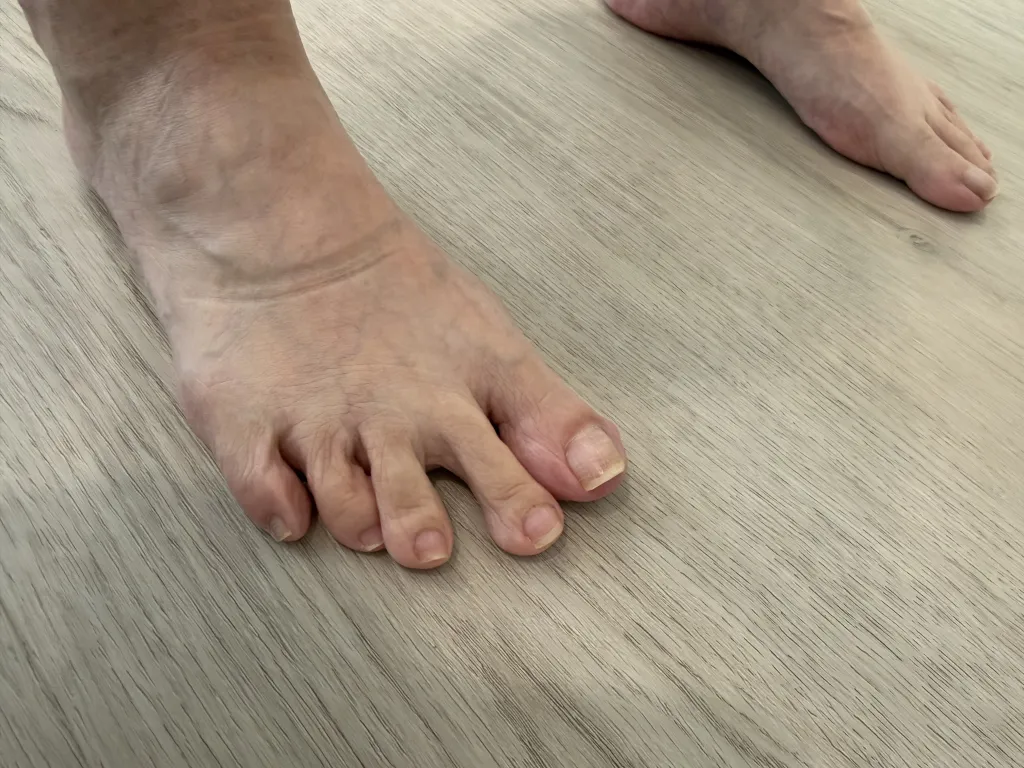
The pain begins under the second toe, just behind it on the ball of the foot. At first it feels like a small stone caught in the shoe. Then the toe starts to look slightly lifted off the floor when you stand. Pressing on the joint reproduces a sharp, achy pain, and a “V”-shaped gap opens between the second and third toes. Long walks, barefoot training, and stair climbing make it worse.
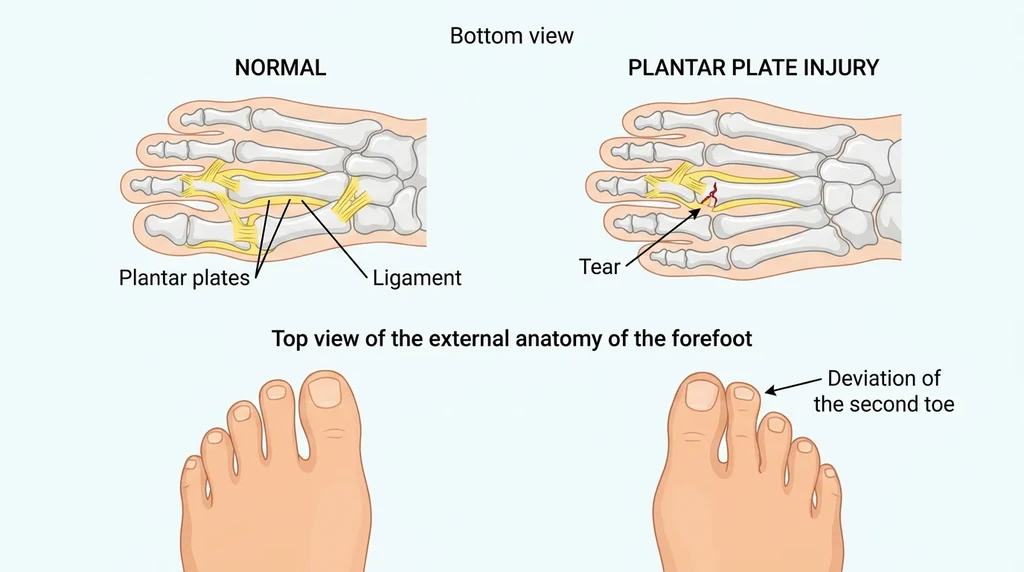
A plantar plate injury is a tear or chronic thickening of the fibrocartilage that sits beneath one of the lesser toe joints, most often the second. The plantar plate stabilises the joint when the toe is loaded during push-off. Once it is damaged, the toe joint loses control, the toe drifts upwards (the “floating toe”), and the pressure under that part of the foot rises. Identifying a plantar plate injury early is important, because untreated tears tend to progress and lead to a fixed deformity of the toe.
Symptoms of Plantar Plate Injury
The symptom pattern is usually distinctive once you know what to look for. A combination of localised forefoot pain and a visible toe position change is highly suggestive.
- Sharp or aching pain just behind the affected toe, usually the second.
- A “stepping on a pebble” sensation under the ball of the foot.
- Swelling around the metatarsophalangeal joint, usually at the sole, particularly after activity.
- A “V” shape (Churchill sign) opening between the second and third toes when standing.
- A “floating” toe that does not fully touch the ground when standing flat.
- Pain reproduced by lifting the toe upwards (positive drawer test on examination).
- Difficulty pushing off during running or fast walking.
Causes of Plantar Plate Injury
A plantar plate injury reflects either a single overload event or chronic excess load on the joint. Most cases involve a combination of biomechanical factors that have built pressure on the plantar plate over months or years before symptoms began.
What Causes Plantar Plate Injury?
- Acute trauma, including stubbing the toe, falling from a height, or a hard landing.
- Repeated hyperextension of the toe during high-impact sport or barefoot training.
- Biomechanical overload, such as excess pronation, a long second metatarsal, or first ray instability.
- A sequela of other pre-existing foot conditions, such as hallux rigidus or bunions, where a malfunctioning big toe joint overloads the lesser toe joints.
- Chronic degeneration of the plantar plate, often alongside lesser toe arthritis.
- Inflammatory joint disease affecting the lesser metatarsophalangeal joints.
Who Carries a Higher Baseline Risk?
- Runners and high-impact athletes, particularly long-distance runners.
- People who train barefoot or in minimalist shoes.
- People with flat feet or high arch feet, both of which change how load is distributed across the forefoot.
- Those with bunions or clawed and hammer toes, which shift pressure onto the lesser toe joints over time.
- A short first metatarsal relative to the second, increasing load on the second joint.
- Existing corns or calluses under the ball of the foot, indicating uneven load.
- Adults with thinning forefoot fat pad.
Conditions Commonly Mistaken for Plantar Plate Injury
Several other forefoot conditions share the same general location and can be confused with a plantar plate tear.
Morton’s neuroma
Morton’s neuroma causes forefoot pain in the same region, particularly when it sits between the second and third toes. The differentiator is the character of the pain. A neuroma tends to cause burning, tingling, or numbness radiating into the toes, while a plantar plate injury produces a mechanical pain under the joint with a visible change in toe position. The two can also coexist.
Metatarsophalangeal joint capsulitis or synovitis
Inflammation of the joint capsule or its lining causes pain and swelling around the same lesser toe joint, and in its early stages it can look very similar to a plantar plate injury. Capsulitis often precedes or accompanies a plantar plate tear, since both involve the same joint under load. The drawer test and the degree of toe drift help separate a stable inflamed joint from one where the plantar plate has actually failed.
Metatarsal stress fracture
A metatarsal stress fracture produces forefoot pain that worsens with activity, overlapping with the plantar plate pattern. The differentiator is the site of tenderness. A stress fracture is tender over the shaft of the bone itself rather than under the joint, and it is confirmed on imaging.
Metatarsalgia from other causes
Metatarsalgia is a general term for pain under the ball of the foot, which can arise from several sources other than the plantar plate, such as a thinning fat pad or uneven pressure distribution. A plantar plate injury is one specific cause of metatarsalgia, distinguished by the localised joint pain, the positive drawer test, and the floating toe.
Treating and Preventing Plantar Plate Injury
Treatment for plantar plate injury aims to offload the damaged joint, calm inflammation, and address the biomechanical factors that caused the injury. Plantar plate tears do not always heal back to original tissue, but with appropriate care most patients return to comfortable activity. The earlier offloading begins, the better the outcome tends to be.
Conservative treatment
Most cases settle with a structured non-surgical plan that offloads the joint, calms the inflammation, and shares load more evenly across the forefoot.
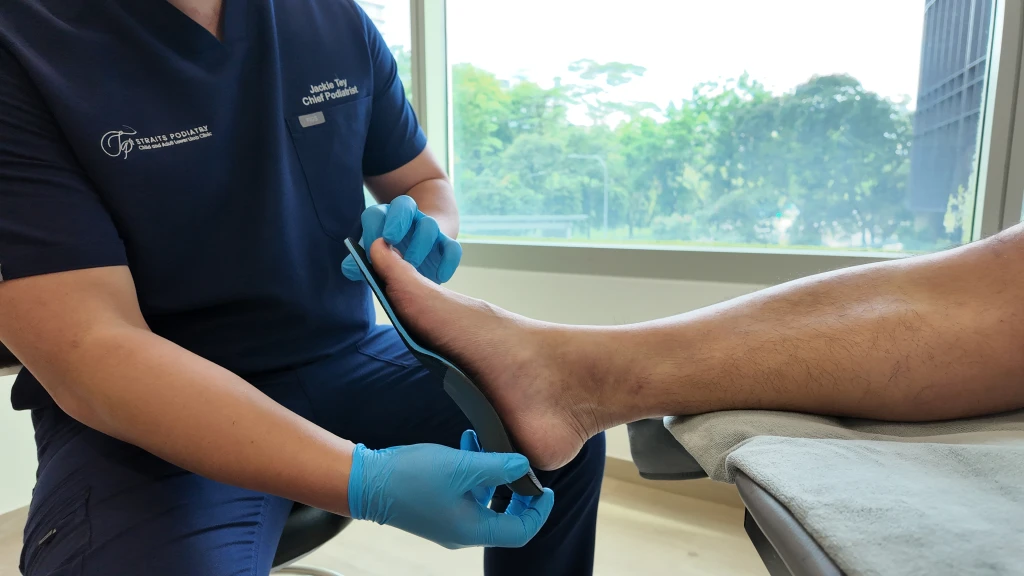
- Customised foot orthoses: Built with a metatarsal pad placed just behind the affected joint to lift load off it, and worn longer term where structural risk factors will not change.
- Footwear modification: A stiff sole or rocker reduces the bending force on the toe joint during push-off. Avoiding barefoot walking and minimalist footwear during recovery protects the joint further.
- Toe taping: Taping the toe in a slightly plantarflexed (downward) position protects the joint and encourages healing.
- Activity modification: Relative rest from running, jumping, and high-impact sport, with lower-impact substitutes such as swimming or cycling, and ice after activity where swelling is present.
- Rehabilitation and physiotherapy: Strengthening the intrinsic foot muscles so they share load with the plantar plate, which lowers the chance of recurrence.
- Extracorporeal shockwave therapy: Aims to stimulate tissue repair around the joint where symptoms are slow to settle.
- Magnetotransduction therapy: Used alongside offloading to reduce pain and inflammation around the joint.
For athletes, reviewing training load, footwear, and running surfaces lowers the chance of the injury returning once symptoms have settled.
When conservative care isn’t enough
Surgical repair is considered when symptoms persist despite a fair trial of conservative care, or when the toe deformity is progressive. A referral to a foot and ankle surgeon is arranged where this pathway is the right one, with imaging and clinical findings guiding the decision. The typical surgical option is a plantar plate repair, though severely torn cases with co-existing joint damage may need a joint fixation.

Have Your Plantar Plate Injury Managed at Straits Podiatry
A plantar plate injury responds best when the joint is offloaded early, before the toe drifts into a fixed position. At Straits Podiatry, our podiatrist confirms the diagnosis with a hands-on examination, including the drawer test, supported by gait analysis and imaging referral where the picture calls for it, so the tear is characterised properly before a plan is set.
From there, care is built around protecting the joint and sharing load more evenly across the forefoot, with targeted taping, custom foot orthoses with metatarsal padding, footwear guidance, and modalities such as shockwave or EMTT where symptoms are slow to settle. Speak with a podiatrist in Singapore or book a consultation for an assessment at any of our three clinics.
Frequently Asked Questions About Plantar Plate Injury
How is a plantar plate injury diagnosed?
Diagnosis is primarily clinical. Your podiatrist will examine the position of the affected toe, look for the “V” sign between the toes, and perform a drawer test, gently lifting the toe upwards to reproduce pain. Imaging is added when the clinical picture is unclear or when surgical planning is being considered. Ultrasound is useful for visualising the plantar plate and surrounding structures. MRI provides the most detailed view of the tear and is often used when more invasive treatment is being planned.
Can a plantar plate tear heal on its own?
Partial tears can become comfortable with offloading even if the tear itself does not fully heal back to original tissue. The body forms scar tissue that, while not identical to healthy plantar plate, often holds the joint well enough for normal walking and most activity once load is managed. Full-thickness tears are less likely to heal without intervention. The key is reducing the load on the joint early, so that whatever healing the tissue can manage is not constantly disrupted by ongoing overload.
How long does recovery take?
For a mild tear with early appropriate treatment, symptoms often improve within six to twelve weeks of offloading. Moderate tears can take three to six months to settle, with continued use of orthoses and footwear modifications afterwards. Severe or longstanding tears with established toe deformity may not fully resolve with conservative care. Continued running or barefoot training during this period typically extends recovery and can worsen the toe deformity. Honest pacing of return to activity matters.
Will surgery fix a plantar plate tear?
Surgery is reserved for cases that do not respond to a fair trial of conservative treatment, or where the toe deformity is progressive. Several procedures exist, including direct repair of the plantar plate and tendon transfers, often combined with metatarsal osteotomy if structural factors are contributing. Surgery has reasonable outcomes for well-selected cases but carries risks including stiffness, persistent pain, and recurrence. Your podiatrist usually coordinates with a foot and ankle surgeon, with imaging and clinical findings guiding the decision.
Can I keep running with a plantar plate injury?
Continuing to run on an injured plantar plate often makes the tear worse and increases the risk of permanent toe deformity. For mild presentations caught early, modified running with orthoses, supportive shoes, and taping may be acceptable for short distances. For more pronounced symptoms or a visible floating toe, the safer path is a structured period of relative rest from running while orthoses, taping, and modalities settle the joint, followed by a graded return. A podiatry assessment helps make that call.