It sounds like one of the most basic self-care tasks imaginable — yet incorrect toenail trimming is one of the top causes of ingrown toenails that we see in our clinic.
Most people have never been formally shown how to cut toenails properly. They do it the way they’ve always done it, often the same way as fingernails, and then wonder why the same toe keeps having problems.
To help you prevent issues like ingrown toenails, we are going to explain exactly how to trim your toenails correctly, what mistakes to avoid, and how to build a routine that keeps your nail away from pain.
Why Toenail Cutting Technique Matters
Your toenails grow approximately 1.5–2mm per month. Each time you trim them, you’re determining what shape the next growing edge will be — and whether that edge will grow cleanly over the skin at the tip of the toe, or angle into the nail groove at the side.
A rounded cut (or we call it “cutting like a rainbow”), a cut that’s too short, or an uneven cut that leaves a spike or sharp corner at the side of the nail creates an edge that, as the nail grows forward, catches on and presses into the soft tissue of the nail fold. Over time (often just a few weeks), this creates the classic irritation of an ingrown toenail. And if you continue to trim the toenails with a rounded cut over a long time, you are causing the ingrown toenail to keep coming back.
The good news: the right technique is simple, and once it becomes a habit, it takes no more time or effort than what you’re doing now.
The Right Tools
Before trying out the technique, you need to get some appropriate tools:
Toenail clippers (not nail scissors)
Toenail clippers are wider and designed for the thickness and width of the toenail. Nail scissors, on the other hand, are designed for fingernails, which are thinner and narrower.
Using scissors on toenails makes it harder to cut cleanly across and increases the likelihood of an uneven, angled cut.
Sharp clippers
Blunt clippers crush rather than cut the nail, which can leave micro-fractures at the nail edge that create irregular, rough edges.
Using a blunt clippers also make nail trimming very uncomfortable as it bends the nail too much when you have to cut it with greater force.
If your clippers don’t cut cleanly (sharp) and cleanly (smooth), replace them.
Nail file
This is a very handy tool to have if you do not have the habit of filing your nails after each trim. A coarse nail file or emery board is useful for smoothing any slight roughness and sharp edges after clipping.
Good Lighting
This sounds obvious, but trimming toenails in dim light is one reason people cut them unevenly or too short. And yes, we see many patients hurting themselves because they tried to trim in the dark.
Good lighting lets you see exactly where the nail edge is in relation to the skin.
Need Help? See A Podiatrist Today
The Correct Technique, Step by Step
1. Soften the nails first
Trim toenails after a shower or bath, or after a brief foot soak. Softened nails cut more cleanly than hard, dry ones. This is particularly important for thick nails.
2. Cut straight across
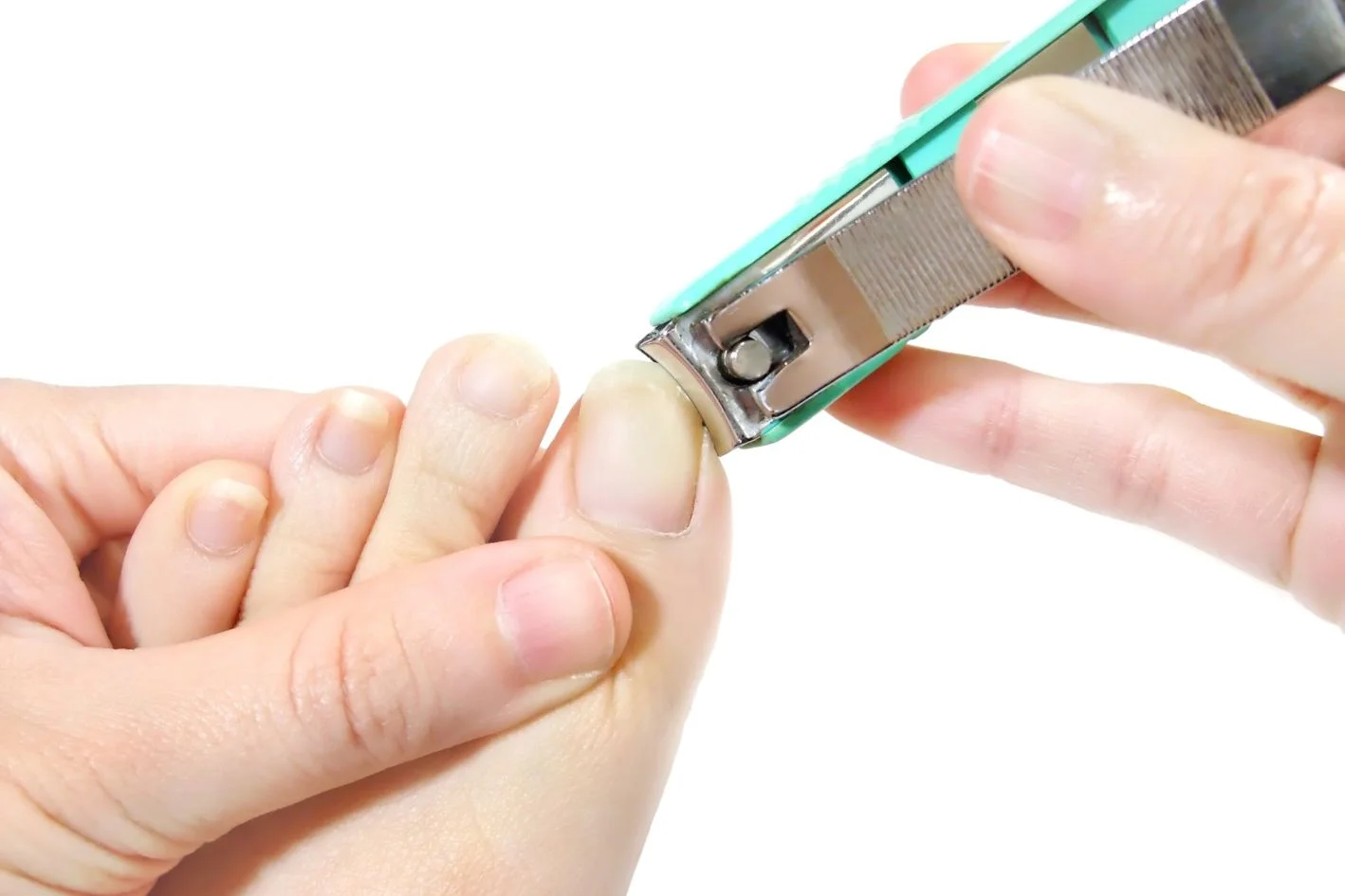
Position the clipper flat against the nail, parallel to the nail surface, and make a single clean cut straight across the nail.
Do not curve the clipper to follow the shape of the toe tip. The cut should be straight — not rounded, not angled.
3. Leave a small amount of free edge
The finished nail should extend just slightly beyond the skin at the end of the toe — approximately 1–2mm of white nail tip visible. This ensures the corners of the nail sit above the skin level at the nail groove, rather than pressing into it.
Do not cut the nail down to or below the level of the skin. This is the most common mistake. It feels cleaner, but it means the nail corner is now level with or below the skin at the groove, where it will press directly into the flesh as it grows.
In simple terms, please leave some whitish bits of nail behind. We know most of you have the urge to make sure all white bits are trimmed away, and that’s incorrect.
4. Do not dig into the corners
After the straight cut, there may be a slight corner at each side of the nail. Leave these alone. Do not use the corner of the clipper to dig into the sides or round them off.
5. File gently to smooth rough edges
After cutting, run a nail file lightly across the top edge of the nail to smooth any roughness.
You can also smooth off the sharp corners so that it does not remain sharp.
This prevents the nail from catching on socks and getting pulled. File in one direction rather than back and forth.
6. Check both sides
Look at each side of the nail and make sure that the corner is slightly visible above the skin level.
If either side appears to be below or at the level of the skin, or if you can see the nail disappearing into the groove, this is a warning sign for an emerging ingrown toenail.
Common Mistakes to Avoid
The most effective things you can do at home for a mild ingrown toenail are also the simplest: warm water soaks, clean dry skin between soaks, open footwear, and not making the nail worse by cutting it incorrectly.
These steps can ease symptoms and give the nail a chance to grow clear of the skin on its own.
But here’s the honest reality: home care works best on mild irritation, and even then, it manages symptoms rather than fixing the nail shape or matrix.
If your ingrown toenail has been recurring, if it’s moderate to severe, or if there’s any sign of infection, professional assessment gives you a faster, safer path to resolution.
Cutting too short
The number one mistake. Short feels clean, but leaves the nail corner level with or below the skin at the groove.
Over-rounding the corners
Cutting in a curved shape, or essentially shaping the nail to match the curve of the toe tip, is exactly how ingrown toenails are created.
This allows the flesh to sit above the curved edges. When the nail grows subsequently, it will then push against the flesh, causing irritation.
Cutting when nails are very dry or thick
Dry, thick nails split rather than cut cleanly. These cracks can leave behind a sharp nail spike at the edges, allowing a disaster to strike.
Our best advice, as we mentioned, is to soak or shower first.
Irregular, uneven cuts that leave spikes
A cut that goes at an angle on one side leaves a sharp spike at the nail corner. This spike is what causes the classic sharp pinch of an early ingrown toenail.
Sharing clippers without cleaning them
Would you share your toothbrushes, even if you clean them after use? Sharing a nail clipper shares the same logic, just not entirely the same. Sharing nail clippers is generally fine as long as they are cleaned after use.
Transmissible nail conditions, such as nail fungus (onychomycosis), can be spread via shared clippers. Dirty clippers also increase your risk of developing signs of ingrown toenail infections.
So always make sure to clean clippers with alcohol between uses if sharing with others, or use your own exclusively.
How Often Should You Trim Toenails?
Toenails grow slower than fingernails, roughly 1.5–2mm per month. Most adults need to trim toenails approximately every 6–8 weeks.
However, this varies based on growth rate (which is faster in younger people and slower in older adults and people with circulation issues) and activity level (increased blood flow from exercise slightly accelerates nail growth).
Our recommendation: if the free edge of the nail is extending more than 2–3mm beyond the skin, it’s time for a trim. If you’re not sure, err on the side of trimming more frequently (taking small cuts each time) rather than less.
Overall, a slightly longer nail is safer than one cut too short.
When You Should Have Nails Trimmed Professionally
Some people should not trim their own toenails, or benefit greatly from professional nail care:
- People with diabetes, poor circulation, or reduced foot sensation — where self-cutting carries risk
- People with significantly thickened nails (often due to fungal infection) that are difficult to cut cleanly at home
- People with very limited mobility or arthritis affecting the hands or hips
- Elderly patients who cannot comfortably and safely reach their feet
Regular podiatry nail care appointments can address all of these situations. Our team can trim nails safely, address any nail edge irregularities that might be developing, and provide ongoing prevention guidance.