Wart Cryotherapy in Singapore
Plantar warts (also called verrucae) have a way of showing up at the worst possible times. That small, rough patch on the ball of your foot or heel might have started as a minor annoyance, but if it has been there for weeks or months without shifting, you are probably wondering what is actually going on and what you should do about it. You may have also tried various over-the-counter options, but they have not worked. You are not alone in asking. Plantar warts are among the more common reasons patients visit a podiatrist in Singapore, and they are also one of the more commonly misunderstood conditions when it comes to treatment.
The short answer is that plantar warts are caused by the human papillomavirus, or HPV. This virus enters the skin through tiny cuts or abrasions, and is most often picked up in shared spaces like swimming pool decks, changing rooms, or gym floors. Because HPV lives within the skin cells rather than sitting on the surface, over-the-counter remedies frequently fall short, especially for warts that have been present for some time. Cryotherapy, or wart freezing treatment, is one of the clinical options available to address this. It works by applying extreme cold directly to the affected tissue, destroying the HPV-infected cells and encouraging the body’s immune system to clear what remains.
How Wart Cryotherapy Works
Traditionally, cryotherapy uses liquid nitrogen, which reaches temperatures of around -196 degrees Celsius, to freeze and destroy the tissue containing the HPV-infected cells. Nowadays, other agents are also available that reach temperatures between -60 and -90 degrees Celsius. When applied to a plantar wart, the extreme cold causes rapid ice crystal formation within and between the wart-infected cells. This ruptures the cell membranes and effectively destroys the infected tissue in a highly localised area.
For plantar warts, which tend to be deeper and more resilient than those on the hands or other parts of the body, a freeze-thaw-freeze technique is often used. This means the freezing agent is applied until a small white halo forms around the wart, the tissue is then allowed to thaw fully, and the freeze is applied once more. Repeating the cycle increases the depth of cellular destruction, which matters because plantar warts can extend deeper into the skin than they appear on the surface.
More than just destroying infected tissue
Cryotherapy is beyond just simple tissue destruction. The controlled injury it creates also stimulates a localised immune response. By drawing the body’s attention to the treated area, cryotherapy may help the immune system recognise and respond to the HPV-infected cells, which it can otherwise fail to detect because HPV is skilled at evading immune surveillance. This immune component helps explain why some patients see nearby, or satellite warts, resolve even without being directly treated.
How it is usually performed
Before cryotherapy is applied, your podiatrist will debride the wart by carefully paring away the overlying callus or thickened skin with a sterile scalpel. This preparatory step is sometimes skipped in less thorough approaches, but it is crucial. Removing the hardened outer layers allows the liquid nitrogen to reach the wart tissue more effectively, rather than simply freezing skin that has already lost its living function. It also gives the podiatrist a clearer picture of the wart’s true size and depth, which informs how the treatment is applied.
Now, it is worth being clear about what the clinical evidence tells us here. Cryotherapy is a widely used and well-recognised treatment option for plantar warts, but it is not always a one-session fix for most people. Research indicates that multiple sessions are often needed, typically spaced two to four weeks apart, and individual responses vary depending on the wart’s size, depth, duration, and the patient’s own immune response.
This is precisely why a podiatrist-led assessment matters. The choice of management, the technique used, and the number of sessions planned should all be tailored to the individual, not applied as a one-size-fits-all approach.
Need Help? See A Podiatrist Today
Who May Benefit from Wart Cryotherapy
Cryotherapy may be a suitable option for patients with plantar warts (verrucae) that have not resolved on their own or for which over-the-counter treatments have not produced adequate results.
It is most commonly considered when:
- The wart has been present for several weeks or months without any sign of improvement.
- Over-the-counter salicylic acid products have not worked.
- The wart is getting bigger, causing pain or discomfort when walking, standing, or engaging in physical activity.
- There are multiple warts present, or a mosaic wart (a cluster of smaller warts that have merged together).
- The wart is on a weight-bearing area, such as the heel or ball of the foot, causing you to change your walking pattern or avoid activity.
Cryotherapy can be used for patients of various ages, including children and teenagers, who are most commonly affected in Singapore. This is particularly true for those who take part in school sports, swimming, or activities that involve walking barefoot in shared facilities.
For younger children, your podiatrist will assess suitability based on the child’s age, the nature of the wart, and their ability to cooperate with the procedure.
Precautions
Patients with diabetes or conditions affecting circulation or sensation in the feet require special consideration before undergoing cryotherapy. Reduced sensation, slower wound healing, and increased infection risk all mean that the decision to proceed needs careful thought. If you have diabetes or any circulatory concerns, please let our team know at the time of booking so we can prepare accordingly.
Cryotherapy is also generally not recommended for immunocompromised individuals or for patients with conditions that affect cold tolerance, such as Raynaud’s disease or cryoglobulinaemia. In these cases, your podiatrist will explain the alternatives available to you.
Other Solutions for Plantar Warts
Besides cryotherapy, plantar warts can also be managed through several other approaches. Knowing where it fits, and where it may not be the most appropriate first step, is part of what distinguishes podiatrist-led care from simply reaching for the nearest pharmacy product.
Over-the-counter products
Salicylic acid preparations, available as gels, plasters, or liquids from pharmacies across Singapore, are usually the go-to option for uncomplicated warts. They work by gradually softening and breaking down the wart tissue over several weeks of daily application. For small, superficial, or recently developed warts in otherwise healthy patients, they can be quite effective.
That said, they demand consistent application over a prolonged period, and many people find that compliance is the real challenge. They are also considerably less effective on deeper, older, or weight-bearing plantar warts.
The danger of doing this is that if used incorrectly or abused, it can cause excessive breakdown of skin tissue, leading to infections and abscesses.
Wart needling and curettage
For warts that have not responded to cryotherapy or topical treatments, wart needling and curettage is another treatment option. Needling involves repeatedly puncturing the wart with a fine needle to disrupt the tissue and introduce HPV proteins into the deeper layers of the skin, where the immune system is more active.
This approach is particularly suited to stubborn or larger plantar warts and has a growing body of clinical evidence supporting its effectiveness in cases that have not responded well to other treatments.
Choosing the right approach for your wart
There is no single treatment that works equally well for every plantar wart. The size and depth of the wart, how long it has been present, whether it is painful, and your overall immune health all influence which approach is likely to give the best outcome.
Some patients respond well to cryotherapy alone; others may need a combination of approaches or benefit from switching to an alternative if the initial response is limited.
This is why your appointment at Straits Podiatry begins with a thorough assessment. Management decisions are always made after examining your wart, not before.
What to Expect at Your Appointment at Straits Podiatry
If you are coming in for wart cryotherapy, here is what a typical appointment at Straits Podiatry involves from start to finish.
Step 1: Assessment first
Your podiatrist will begin by carefully examining the affected area. Not everything that looks like a plantar wart is one. Corns, calluses, and certain skin lesions can look similar, and a correct diagnosis is important because the treatment approaches differ.
Your podiatrist will also review your medical history, ask about how long the wart has been present, what you have already tried, and whether any underlying health conditions may affect how the procedure is performed or how your skin heals afterwards.
Step 2: Debridement before treatment
Before cryotherapy, your podiatrist will carefully pare down any overlying callus or thickened skin using a sterile scalpel. This is done with care to keep you comfortable, and it is an important step in ensuring the cryotherapy reaches the wart tissue itself rather than being absorbed by the hardened outer layers that commonly build up on weight-bearing areas of the foot.
Step 3: Cryotherapy application
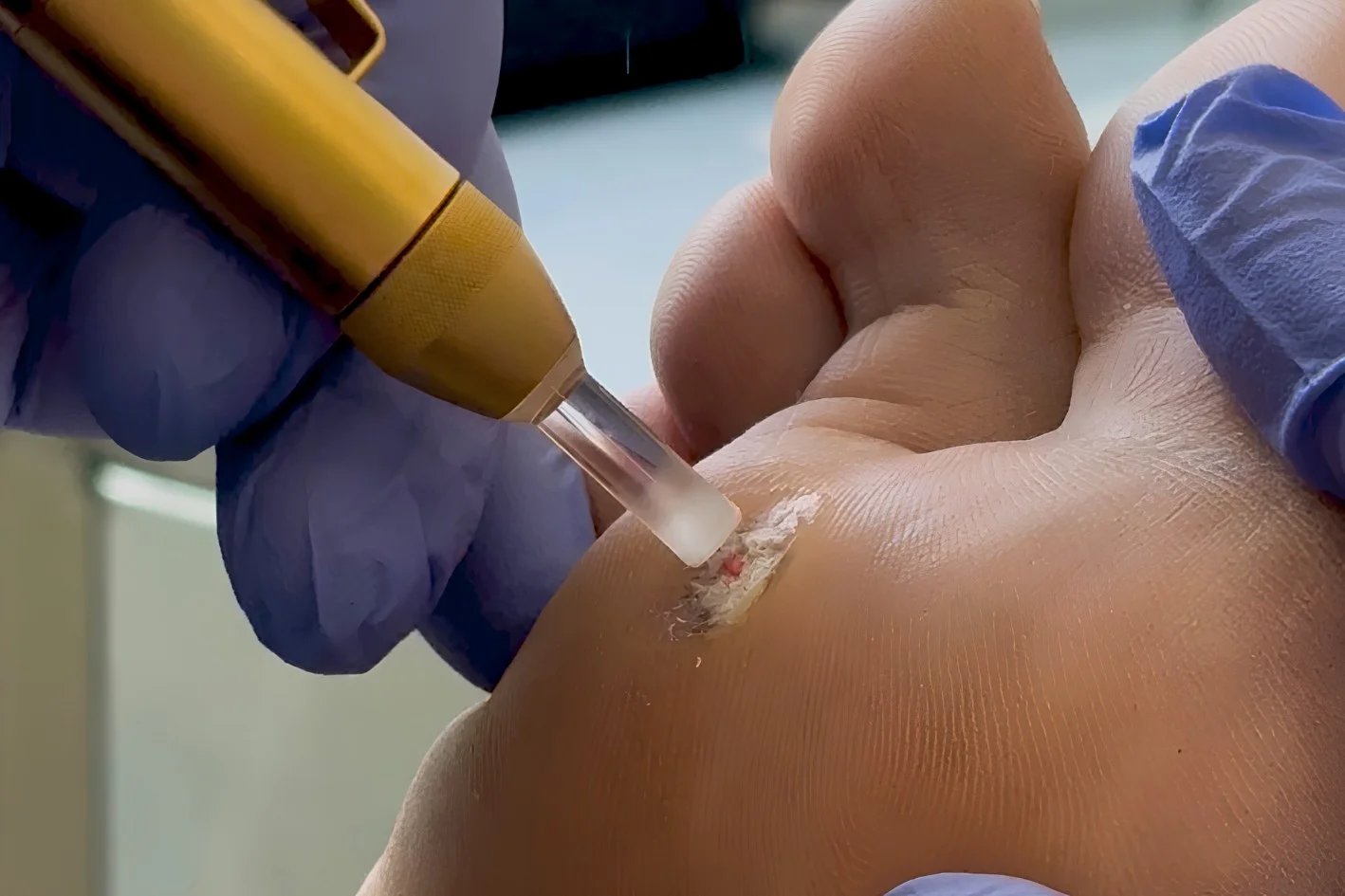
The freezing agent is applied using a precision cryotherapy device, via a controlled applicator tip. You will feel an intense cold sensation, followed by a stinging or burning feeling that most patients describe as brief but noticeable.
For plantar warts, the freeze is typically held for 10 to 30 seconds, depending on the wart’s size and depth. A freeze-thaw-freeze cycle may be used for more established warts. The procedure itself usually takes only a few minutes per wart.
After the session
Some soreness and tenderness in the treated area are normal after the session, which may last for the next 48 hours.
A blister may develop within 24 hours, and this is a normal, expected part of the healing response. It should not be punctured. The blister, if formed, will gradually resolve over the following week or two.
Your podiatrist will give you clear instructions on how to care for the area at home, including how to keep it clean, whether to use a protective dressing, and what signs to watch for that might indicate a problem.
Follow-up sessions
It is normal for plantar warts to require more than one cryotherapy session to be removed. Follow-up appointments are typically scheduled two to four weeks apart to allow the targeted tissue to heal and to assess how the wart is responding.
At each follow-up, your podiatrist will review progress and advise on whether to continue with cryotherapy, consider an additional or alternative approach, or monitor for recurrence if the wart has cleared.
Our approach at Straits Podiatry
We are always patient-first here. Our podiatrists will not recommend a treatment unless the assessment supports it. You will receive a clear explanation of your diagnosis, the rationale for any management under consideration, and an honest picture of what to realistically expect. There is no pressure to commit to anything on the day. We want you to feel informed and confident in any decision you make, and we will always give you the space to ask questions at your own pace.
Ready to Have Your Plantar Wart Assessed?
Plantar warts rarely improve faster by waiting. The longer they are left, the more established they tend to become, and the harder they are to shift. If you have a wart on your foot that has persisted despite self-treatment, is causing pain, or is simply not going away, getting a proper podiatrist assessment is the most reliable next step. A podiatrist can confirm the diagnosis, explain your options clearly, and recommend the management approach most likely to work for your specific situation.
To book a consultation, you can book an appointment online or reach our team by phone. We see patients at our clinics in Buona Vista, Katong, and Orchard. We are here to help you find the right answer for your feet.
Frequently Asked Questions About wart cryotherapy
Is wart cryotherapy painful?
Most patients find the procedure uncomfortable, with a brief stinging pain. The intense cold sensation is followed by a stinging or burning feeling that typically lasts for a minute or two. After the session, some tenderness and aching in the treated area is normal and may last up to 48 hours.
For deeper or larger plantar warts, the sensation during the freeze-thaw cycle can be more pronounced. If you are concerned about pain, let your podiatrist know at the start of the appointment so they can talk you through what to expect and manage your comfort as much as possible.
How many sessions of cryotherapy will I need?
This varies depending on the individual wart and the patient’s own immune response. Some smaller or more superficial warts may clear after two or three sessions. Deeper, older, or more stubborn plantar warts usually require more.
Sessions are typically spaced two to four weeks apart to allow the targeted tissue to heal before the next application. Your podiatrist will give you realistic expectations at your first assessment, and the plan will be reviewed at each follow-up visit based on how the wart is responding.
Can I walk normally after the treatment?
Most patients can walk after the procedure, although the treated area may feel sore for a day or two, particularly when weight is placed directly on it. Wearing comfortable, well-cushioned footwear is recommended in the days following your session. If a blister develops, it is important not to burst it. Your podiatrist will advise you on how to protect the area and when it is safe to return to your normal activities, including sport or exercise.
Will the wart come back after cryotherapy?
Recurrence is possible with any wart treatment, because HPV can persist in the surrounding skin even after the visible wart has cleared. Your podiatrist will advise on aftercare steps that may help reduce this risk, such as avoiding walking barefoot in communal areas and keeping the feet clean and dry.
If a wart returns in the same area, it can be cleared again. In such cases, an alternative approach such as wart needling may be considered, particularly if cryotherapy alone has not produced a lasting result.
Is cryotherapy suitable for my child's wart?
Cryotherapy can be appropriate for children and teenagers, though suitability depends on the child’s age, the size and location of the wart, and their ability to stay still during the procedure. Plantar warts are common in school-age children in Singapore, particularly those who swim or play sports in shared facilities.
If you are bringing a child in, your podiatrist will assess whether cryotherapy is the right option and will work to make the experience as calm and comfortable as possible.
Share this with someone you know